Most small businesses that have a COSHH assessment think they’re covered. Many of them aren’t. The issue is rarely a complete absence of documentation — it’s documentation that looks right on the surface but wouldn’t survive an HSE inspection. These are the six mistakes we see most often, and what to do about each one.
Mistake 1: Using a generic downloaded template
This is by far the most common COSHH mistake. A business owner Googles “COSHH assessment template,” downloads the first result, fills in a few fields, and considers the job done. The problem is that a generic template is not a COSHH assessment — it’s a starting point.
A compliant COSHH assessment must reflect the actual substances used at your specific workplace, in your specific work processes, by your specific staff. It must include accurate hazard classifications, realistic risk ratings, and controls that are actually in place. An HSE inspector reviewing a generic template will spot it immediately — the language will be vague, the controls will be generic, and the substance descriptions won’t match your actual products.
The fix: Either tailor a template properly to your workplace and substances, referencing the actual Safety Data Sheet for each product, or have a qualified consultant produce it for you. The document must be specific to your business.
Mistake 2: Leaving substances off the assessment
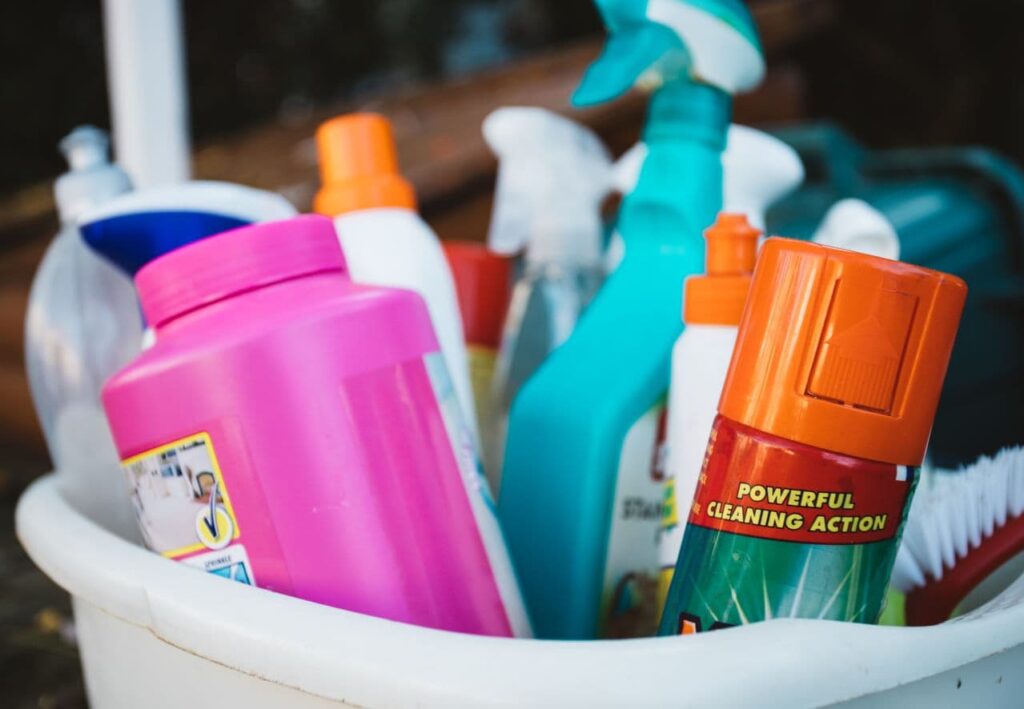
When businesses list the substances they use, they tend to think of the obvious ones — the industrial chemicals, the specialist products. What they forget are the everyday items that are so familiar they don’t register as hazardous: the spray cleaner under the sink, the hand sanitiser by the door, the descaler in the kitchen, the WD-40 in the workshop.
If a product has a hazard warning symbol on its label — a flame, an exclamation mark, a skull and crossbones, or any GHS/CLP pictogram — it requires a COSHH assessment. The regulations do not make exceptions for products that seem mild or that are widely used domestically.
The fix: Walk through every area of your workplace and make a comprehensive list of every product used. Check every label. If there is a warning symbol, it goes on the list. Include products stored as well as products actively used — storage carries its own risks.
Mistake 3: Not keeping Safety Data Sheets on site
A Safety Data Sheet (SDS) is a document produced by the substance manufacturer that sets out everything you need to know about a hazardous substance — its composition, hazards, exposure limits, first aid measures, handling and storage requirements, and disposal information. Your supplier is legally required to provide one for every hazardous substance.
Many businesses have COSHH assessments but no SDS on site for the substances assessed. This is a problem for two reasons. First, your COSHH assessment should be based on the SDS — the hazard classifications and exposure information in your assessment should come from the SDS. If you don’t have the SDS, you may have assessed the wrong hazards. Second, an HSE inspector will ask to see them.
The fix: Request an SDS from your supplier for every hazardous substance you use. Keep them in a folder that is accessible to all employees — not locked away in a drawer. Review them when you buy new products or when a supplier changes their formulation.
Mistake 4: Not reviewing assessments annually
Under COSHH Regulations, assessments must be reviewed regularly — and in practice, that means at least every 12 months, and also whenever there is a significant change. A change in the substances you use, a change in your work processes, a new member of staff, a new supplier, or a change in the available controls should all trigger a review.
Many businesses complete a COSHH assessment once and never look at it again. A four-year-old assessment sitting in a filing cabinet is not compliance. An HSE inspector will check the review date — and if the document hasn’t been touched since it was first produced, it is a clear signal that COSHH is not being actively managed.
The fix: Put a review date in your calendar — 12 months from the date of the assessment. Make it a standing annual task. When you review, check whether any substances have changed, whether new products have been introduced, and whether the controls described are still accurate and in place.
Mistake 5: Completing the assessment but not telling staff
Producing a COSHH assessment is only part of the requirement. The regulations also require that the findings are communicated to the employees who work with the substances. This means staff must know which substances are hazardous, what the risks are, what controls are in place, and what to do if something goes wrong.
It does not need to be a formal training course — a toolbox talk, a briefing, or even a documented conversation can be sufficient for a small business. But there must be some evidence that the information has been shared. A document that sits in a drawer and has never been read by a single employee is not compliant.
The fix: When you complete or review a COSHH assessment, brief your relevant staff on the findings. Keep a simple record — a sign-off sheet with names and dates is enough. This demonstrates to an inspector that the assessment is being actively used, not just filed away.
Mistake 6: Recording controls that aren’t actually in place
This is a subtle but important mistake. When completing a COSHH assessment, it is tempting to write down the controls that ought to be in place — PPE provided, ventilation adequate, storage in a locked cabinet — without checking whether they actually are. An assessment that records controls that don’t exist is worse than no assessment at all, because it demonstrates awareness of the requirement without compliance.
An HSE inspector will not just read your assessment — they will look around your workplace. If your assessment says PPE is provided and used, they will look for evidence of PPE. If your assessment says substances are stored in a ventilated cabinet and they are actually stacked under a workbench, you have a problem.
The fix: Complete your COSHH assessment as a live document — walk around your workplace as you fill it in, and record only what is actually there. If controls are missing, record them as required additional controls with a target date for implementation. Then implement them.
How to know if your COSHH documentation is actually compliant
The honest test is simple: if an HSE inspector walked through your door tomorrow and asked to see your COSHH assessments, would you be confident handing them over? Would they reflect your actual workplace, your actual substances, and your actual controls? Would the review dates be current? Would your staff be able to confirm they’ve been briefed on the findings?
If the answer to any of those questions is no, your documentation needs attention — and it’s better to sort it now than after an inspection.
Get your COSHH documentation sorted properly
Ironshore Safety produces COSHH assessments for small businesses across the Southwest. Every assessment is tailored to your specific workplace and substances, produced by a qualified consultant — IOSH Managing Safely certified — and turned around within 5 working days. Fixed pricing from £350, with no hidden costs.
Get in touch for a free 15-minute call — I’ll tell you exactly what your business needs and what it’ll cost. No obligation.
Ironshore Safety is based in Braunton, North Devon and serves businesses across the Southwest.