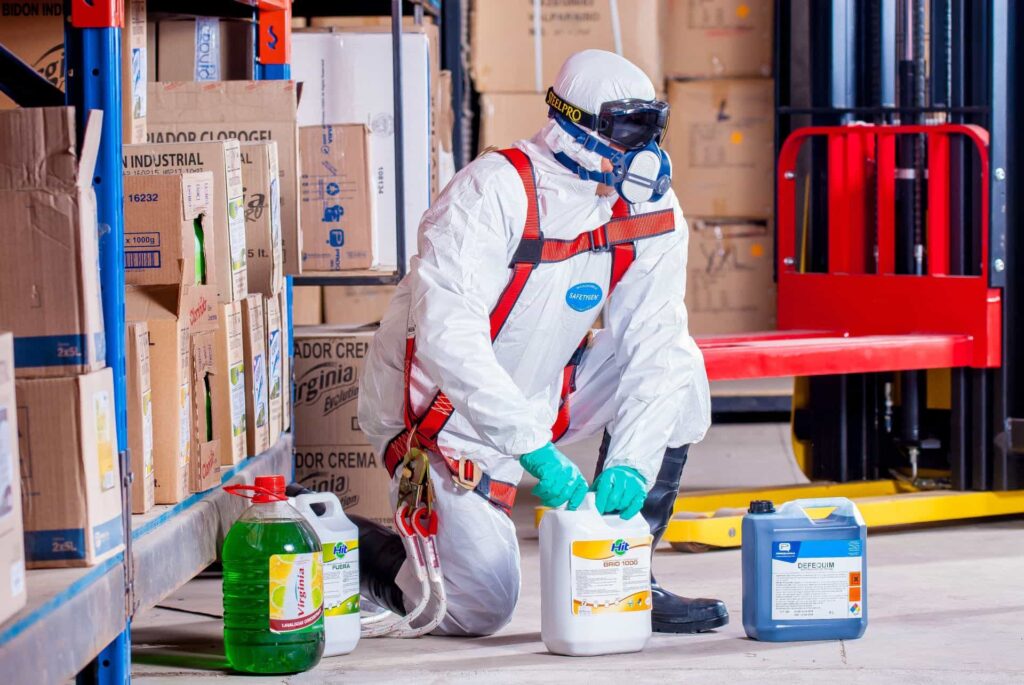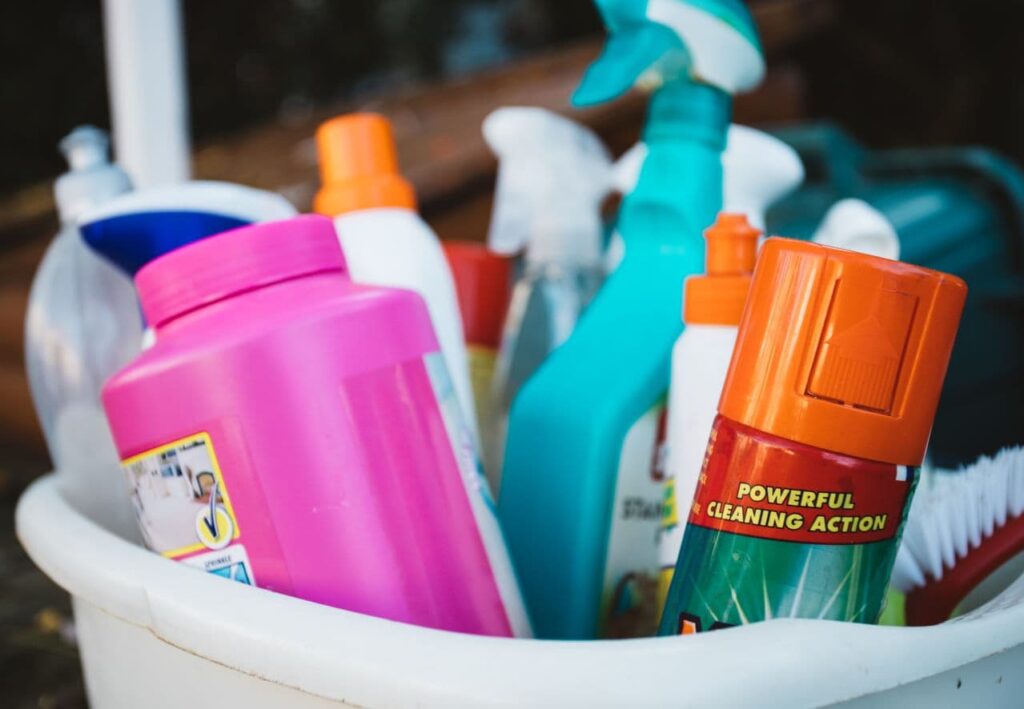
Cleaning companies are among the businesses most likely to face HSE scrutiny over COSHH compliance — and among the least likely to have documentation that would hold up to inspection. The substances used in commercial cleaning are genuinely hazardous, the staff using them are often untrained in the regulations, and the documentation that exists is usually a generic template that bears no resemblance to the actual products being used. This guide covers what cleaning companies need to have in place, and why.
Why cleaning companies are high risk for COSHH non-compliance
Every product a cleaning company uses — every disinfectant, descaler, bleach, degreaser, floor stripper, and sanitiser — is almost certainly a hazardous substance under COSHH. Unlike industries where hazardous substance use is obvious, cleaning companies often underestimate their exposure because the products seem familiar. Bleach is bought in supermarkets. Disinfectant is used in homes. They don’t feel industrial.
But the Control of Substances Hazardous to Health Regulations 2002 does not make exceptions for familiarity. If a product has a hazard warning symbol on the label — a corrosion symbol, an exclamation mark, a health hazard diamond — it requires a COSHH assessment. For a typical commercial cleaning company, that means virtually every product in the van.
What substances need to be assessed?
For a commercial cleaning company, a COSHH assessment is likely to be required for all of the following:
- Bleach and chlorine-based disinfectants
- Multi-surface and antibacterial sprays
- Bathroom and toilet cleaners
- Descalers and limescale removers
- Oven and grill cleaners
- Floor strippers and degreasers
- Glass and window cleaners
- Carpet and upholstery cleaning solutions
- Drain unblockers
- Hand sanitisers and skin care products
- Laundry and dishwasher chemicals where used
If the product has a Safety Data Sheet — and your supplier is legally required to provide one for any hazardous substance — it requires a COSHH assessment. If you are not sure whether a product is covered, check the label for GHS/CLP pictograms. Any symbol means it is covered.
What does a COSHH assessment for a cleaning company need to include?
For each substance, a compliant COSHH assessment must cover:
- Substance identification — the product name, manufacturer, and form (liquid, spray, concentrate)
- Hazard classification — corrosive, irritant, toxic, harmful — taken from the Safety Data Sheet
- Routes of exposure — skin contact, inhalation of fumes or aerosols, eye contact, accidental ingestion
- Who is at risk — cleaning operatives, supervisors, members of the public in the area being cleaned
- Existing controls — PPE provided, ventilation, dilution ratios, product substitution where safer alternatives exist
- Additional controls required — anything that needs to be put in place that isn’t already
- Risk rating — before and after controls are applied
- Review date — assessments must be reviewed at least annually and whenever products change
The assessment must also be communicated to the staff who use the substances. This means your cleaning operatives need to know which products are hazardous, what the risks are, what PPE to use, and what to do if something goes wrong. A document that has never been read by a single operative is not compliant.
Why generic templates are a particular problem for cleaning companies
A downloaded COSHH template will list common cleaning substances in generic terms — “bleach,” “disinfectant,” “degreaser.” A compliant assessment lists the actual products your company uses, with the actual hazard classifications from the actual Safety Data Sheets for those products.
The difference matters because different products carry different risks. A chlorine-based bleach and a hydrogen peroxide-based cleaner are both “bleach” in generic terms, but they have different hazard profiles, different exposure limits, and different emergency procedures. An inspector who pulls out your assessment and finds it doesn’t match the products in your operatives’ cleaning kits will not accept it.
Specific risks for cleaning companies to address
Beyond the standard COSHH requirements, cleaning companies have several specific risk factors that a thorough assessment should address:
- Mixing products — mixing bleach with ammonia-based products produces toxic chloramine gas. This is a documented risk in cleaning environments and must be explicitly addressed
- Concentrate handling — many commercial cleaning products are supplied as concentrates and diluted on site. The concentrate is often significantly more hazardous than the diluted product, and handling procedures need to reflect this
- Spray inhalation — operatives using trigger sprays in enclosed spaces — bathrooms, kitchens, small offices — are at risk of inhaling aerosols. Ventilation controls and respiratory PPE requirements should be documented
- Skin sensitisation — prolonged exposure to cleaning chemicals is a leading cause of occupational dermatitis. Glove provision and skin care protocols must be in place and documented
- Lone working — cleaning operatives often work alone in client premises. Emergency procedures and first aid arrangements need to account for this
What PPE is required?
PPE requirements should be specified in the COSHH assessment for each substance. For most cleaning products, this will include:
- Chemical-resistant gloves — nitrile or rubber depending on the substance
- Eye protection — goggles or safety glasses where splashing is a risk
- Apron or protective clothing for concentrated products
- Respiratory protection for high-aerosol environments or concentrated products
PPE is the last line of defence — the assessment should also consider whether exposure can be reduced through product substitution, dilution, or improved ventilation before relying on PPE alone.
Do subcontractors and self-employed cleaners need a COSHH assessment?
Yes. The COSHH Regulations apply to the self-employed as well as employers. If you are a sole trader operating a cleaning business, you are required to assess the hazardous substances you use. If you supply cleaning operatives to clients, you are responsible for their COSHH assessment regardless of their employment status.
How often does a cleaning company COSHH assessment need to be reviewed?
At least annually, and also whenever you introduce a new product, change supplier, change the concentration or application method of an existing product, or when a new operative joins the team. Cleaning companies tend to change products relatively often — switching to new suppliers, trialling new formulations — and each change potentially requires an update to the assessment.
This is one reason cleaning companies benefit from an annual retainer arrangement rather than a one-off assessment. Products change, staff change, client sites change. A retainer ensures your documentation stays current without you having to think about it.
Get your COSHH assessment sorted
Ironshore Safety produces COSHH assessments for cleaning companies across the Southwest. Every assessment is tailored to the specific products your company uses — not a generic template — and produced by a qualified consultant, IOSH Managing Safely certified. Fixed pricing from £350 for up to 10 substances, turned around within 5 working days.
If you need both a COSHH assessment and a general risk assessment, our bundle at £575 covers both and saves you £70.
Get in touch for a free 15-minute call — I’ll tell you exactly what your business needs and what it will cost. No obligation.
Ironshore Safety is based in Braunton, North Devon and serves businesses across the Southwest.